TECHNOLOGY

The digital infrastructure powering software-defined ships
Every sensor, every signal, every system — unified under one AI-ready architecture, built and proven on the open ocean.
Software-Defined Ships
Re-Architecting Hull, Mechanical & Electrical (HM&E) from the Keel Up.
We redesigned ships from first principles, starting from the engine room out. Around our engine modules, we built a fully software-defined ship with smart, modular components designed to swap out for rapid repair. Together, they become building blocks: many ships, in many shipyards, for many missions.

The architecture meets and exceeds U.S. Navy requirements and is not limited to any single hull or program. Liberty Class is the first platform — the same foundation applies wherever autonomous ship operation is required.
Open Keel
The operating system for software-defined ships
Every sensor. Every signal. Every system. Unified.

Most ship automation is proprietary and siloed. Data gets locked in OEM-controlled black boxes. AI has nothing to reason over.

Open Keel is BWA's open architecture platform: the connective tissue integrating every subsystem on a vessel into a single, AI-ready data layer — propulsion, power generation, fuel management, sensors, bilges, navigation, machinery control. All of it flows through Open Keel, and every hour of operation makes the system smarter.Open Keel is the foundation every other capability in this stack is built on.
Navigation Autonomy
Built on Foundation Models. Not Legacy Pipelines.
The navigation stack combines data input from a variety of sensors into a unified operating picture: 360° computer vision coverage, day and night, in any weather. Processing is done onboard without any need for external communications.

BWA partners with multiple leading navigation autonomy partners, combined with our own specialized robotics expertise to deliver best in class capabilities. Where traditional systems only classify objects they've seen before, our stack is built on modern foundation models adapted specifically for the maritime domain. It generalizes novel encounters in real time, no retraining, no software update, no gap in coverage.

Our navigation autonomy system is COLREG compliant and supports passive EO/IR for full EMCON operation.Tested day and night in New England open water conditions.
Engineering Autonomy
Autonomous Chief Engineer (A-CHENG)
Automation monitors. Automation alerts. Automation stops. A-CHENG acts.

The difference in practice:
01
Traditional automation
A fuel tank level sensor fails. The system loses its primary input, assumes the worst, halts operations, and alerts the crew — with no diagnosis and no lead. Hours lost chasing a false reading.
02
A-Cheng
Activates pumps to check pressure and flow, cross-references maintenance records, and reasons through a likely installation error — all before anyone picks up the phone. Operations continue. The fix is targeted.
That kind of reasoning doesn't come from software alone. A-CHENG was built with mariners holding 100-ton licenses and decades of hands-on experience managing engineering plants at sea. Their knowledge of how ships actually fail, and how engineers actually diagnose them, is encoded into how A-CHENG thinks.

Whereas automation follows a script, A-CHENG has an objective. It manages the whole ship's engineering plant, allowing it to run for months at a time without human technicians, maintainers, or engineers.
Engine Modules
Containerized power. Swappable in hours.
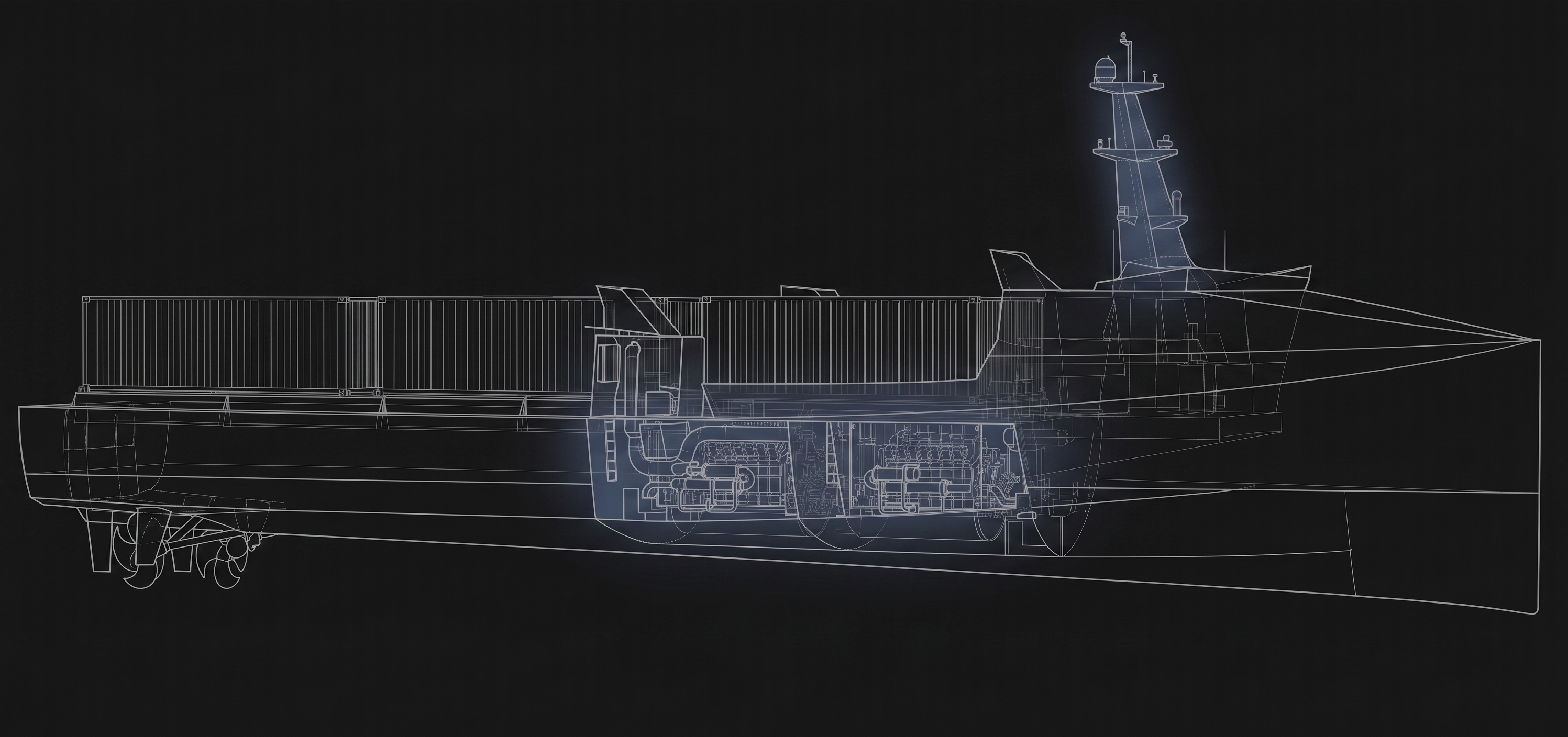
Blue Water ships are powered by diesel engine modules built into 20’ ISO containers. Together, multiple containerized engine rooms form a microgrid, generating megawatts of clean power that feeds an electric grid. The grid in turn powers everything on the ship from propulsion to payloads.

Each module is designed for high endurance on its own, with sensing and automation managing lube oil, filtration, and thermal control to keep the engine running without intervention. But the real reliability comes from how they work together: multiple modules powering a shared electrical grid, so the ship keeps operating even if one goes offline. Together they enable 2-3 months of no-touch operation at sea.

When a vessel returns to port, the components most in need of maintenance are all inside the module. Modules are built around a standard 20' ISO container, making them moveable at any commercial port and replaceable in hours. With this approach, maintenance of critical ship systems is divorced from the ship’s operating schedule.
Result: 90% operational availability. Compared to ~65% for unmanned ships with conventional architecture and ~40% for crewed vessels.
The same modular architecture proven on our Autonomous Test Vessel (ATV) is the foundation for Liberty Class, and is designed to integrate into any vessel requiring autonomous, long-endurance power generation.
System Validation
Build a Little. Test a Little. Learn a Lot.
Tow Tank
Hull designs are validated at MIT's tow tank alongside MIT's ocean engineers. For Liberty, this testing confirmed Sea State 7 survivability (6-9 meter waves) and 27-knot top speed, at scale, before steel is cut.
R&D Lab
Prior to hitting the water, we test critical components and systems in our lab on land. Cooling loops, electrical panels, and sensors all undergo hundreds of reps and sets in isolation, before integration onto the ATV or the ship.
Autonomous Test Vessel (ATV)
Ironsides 100 feet, 170 tons, 2200+ engine hours on the open water. The ATV validates BWA's full ship stack in real conditions: diesel-electric power generation, fuel management, cooling, bilge, propulsion, and navigation autonomy, all under continuous A-CHENG supervision. Every subsystem progresses through software-in-the-loop, hardware-in-the-loop, and open-water testing before ship integration.
Atlantic Endurance
82-foot crew transfer vessel selected for its speed capability and upgraded with BWA's full navigation autonomy stack: 5 cameras, 2 radars, INS, full compute cluster, and navigation autonomy in partnership with MarineAI. On-water COLREGs testing five days per week.
Built with the best