
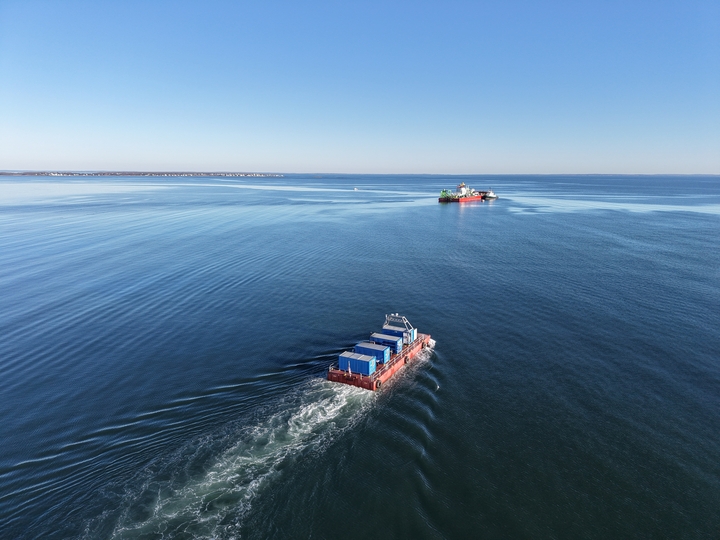
This week, the Blue Water team reached a significant milestone in our journey: surpassing 1000 hours of ocean-based testing of our proprietary propulsion system designed for autonomous surface vessels. Achieving this milestone surpasses the Navy’s original 720-hour land-based test requirement while also including the addition of fuel polishing, electric power generation, and a full sensor suite.
Meeting the Navy's Vision
As the Navy expands its fleet of uncrewed ships to execute transoceanic missions, vessels will need to remain at sea unmanned for months at a time. Robust engine and propulsion systems are essential building blocks for the hybrid fleet. If a ship can’t make way, nothing else matters. While previous Navy testing focused on the 720-hour baseline mandated by Congress in 2021, Blue Water set out to push beyond this threshold and validate our systems under more demanding and realistic maritime conditions.
Real-World Testing at Scale
Our testing was conducted on a 165-ton, 100 ft long vessel based in New Bedford, MA which integrated the components needed for the Navy's Medium Unmanned Surface Vessel (MUSV) program including propulsion, fuel management, power electronics, engines, electric motors, and autonomy sensors.
By conducting testing on the ocean, rather than in a laboratory, we aimed to get closer to the full spectrum of challenges a ship encounters in the offshore maritime environment:
- Continuous operations: Testing 7 days per week across 3 shifts per day.
- Exposure to harsh environments: Saltwater corrosion, biofouling, UV radiation, vessel motion, and temperature extremes.
- Varied load profiles: Designed to operate inside and outside of the engine’s optimal power rating.
Philosophy: Early Decisions Cast Long Shadows
Before testing began, our team recognized that there were some decisions that were critical to get right the first time because they would be very difficult to change later. We deliberately slowed down to research options thoroughly to make informed choices. We also knew that there were decisions that could be changed later and for these, we moved quickly. We prioritized speed and made decisions based on available information, tested rapidly, and fixed our mistakes as needed.
Embracing Failure to Accelerate Learning
Unlike the traditional approach to ship construction where experimentation is limited and failure is penalized, we focused instead on maximizing our rate of learning. We didn't fear failures; we celebrated them as opportunities to gain a deeper understanding of the inner workings of complex and highly coupled systems. Because our system architecture is modular, we could swap and modify components quickly to incorporate new designs based on our testing.
For each failure encountered, we conducted extensive root cause analysis and incorporated those learnings into the process going forward. Success is ultimately getting every detail correct — every hose, connector, bolt, and fitting matters.
Building Layers of Reliability
Our reliability strategy doesn't rely on a silver bullet — it comes from many deliberate, incremental improvements:
- Start with quality: High-quality diesel engines from American suppliers.
- Use long-life components: Such as synthetic lubricating oil.
- De-rate systems: Running cooler with less stress extends lifespan.
- Minimize vibrations: Reducing the primary cause of leaks and chafe.
- Modify for durability: Reduce connector count, replace hoses with welded pipe, eliminate chafe points, polish fuel.
- Add safeguards: Pressure socks over connectors to contain fluid from potential leaks
- Automate preventative maintenance: Including automated lube oil changes.
- Detect and anticipate: Monitor for leaks, overheating, and vibration, then modify system behavior to minimize effects.
- Employ redundancy: Ensuring the overall propulsion system, not just individual components, meets requirements.
Looking Forward
This 1,000-hour milestone is the first in many to come as we continue to test and challenge our systems with the mission to extend autonomous operations at sea. We are excited for the next 1000 hours, and we are devising new ways to challenge and harden our system with the goal of bringing the Navy's vision of a resilient, hybrid fleet to reality.